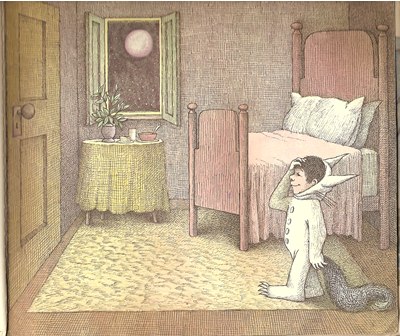
Page-by-Page Analysis * First picture: Max
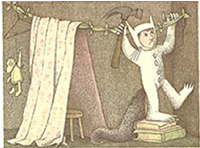
looks angry in the picture; he wears his "wolf suit"
(why?), and is hammering nails into the wall; a teddy bear (or
something - maybe a stuffed wolf) is hanging from coat hanger.
Much suggestion of "acting-out" behavior, serious bad
actions or psychological disturbance, but the text refers only
to "mischief" - perhaps an example of the text contradicting
the picture.
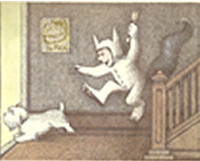
* Second picture: Max is chasing the dog (which looks like the
hero of Higgledy Piggledy Pop, which was based on Sendak's own
dog); the background shows monster picture "by Max"
nailed to wall, suggesting earlier instances of "mischief"
have made him familiar with the wild things. Query: the picture
is hung neatly - does this suggest perhaps that his mother has
put it up for display? If so, what are the implications for Max's
relationship with his family?
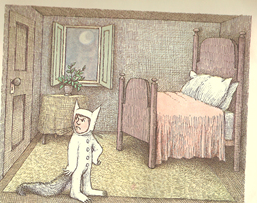
* Third picture: He is closed in his bedroom, still wearing wolf
suit, still looking very angry. The text tells us the anger is
directed at his mother, who has called him "Wild Thing"
and sent him to bed without supper after he shouted "I'll
eat you up!"
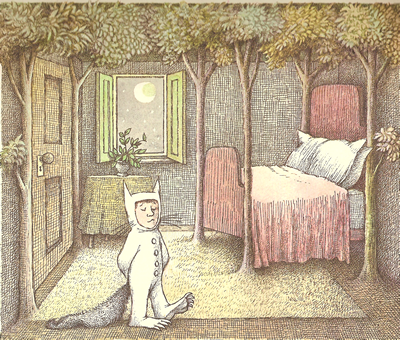
* Fourth picture: The forest is growing in Max's room, and Max
now appears almost nonchalant. (The imagery of the forest growing
out of the bed room echoes a similar description in George MacDonald's
work, which Sendak is familiar with.)
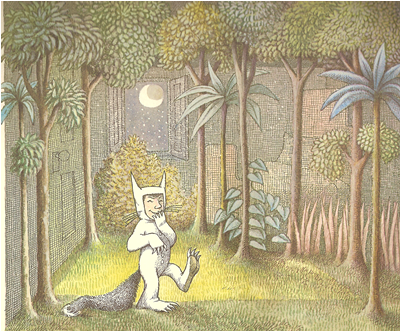
* Fifth picture: The forest grows even more, the bedroom fades
into background, and the moon appears brighter. But the illustration
here resembles a theatrical set, perhaps suggesting that the ensuing
events are being acted out in the theatre of Max's imagination;
note the line across the bottom, just behind Max, as if this were
a painted screen. Max now is smiling and laughing into his hand,
enjoying a joke? - no longer angry, but ratheras if he is getting
the last laugh on Mom.
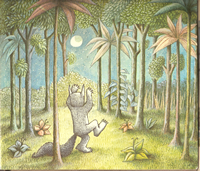
* Sixth picture: The bedroom has disappeared; nothing is visible
but the forest, and Max has his back to us. "The walls became
the world all around" - the child's imagination converts
an unpleasant environment into a world of adventure which he controls,
and also literalizes what he feels: when he is confined to his
room, the room does become the world all around him, or all the
world to him. The picture now occupies a full page, having grown
larger to this point; for the first time in the book, the space
devoted to text and the space devoted to picture are in equilibrium.
From here to the book's climax, the pictorial elements will continue
to expand at the expense of the text space (perhaps a reflection
of the dominance of the imagination); once Max's "wild-thing"
energy is spent, the pictures shrink again until in the final
spread there is only text, no picture at all.
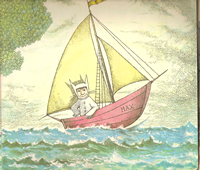
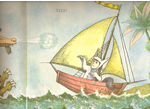
* Seventh picture: The ocean with the boat appears, and Max looks
peaceful, happy.
* Eighth picture: The text (here and on the previous page) suggests
passage through time, perhaps evoking the sense that a change
in behavior comes with maturity, achieved through time. Max sees
the first "wild thing" and looks worried; he raises
hands/paws to fend off the sea creature.
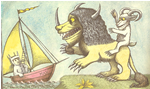
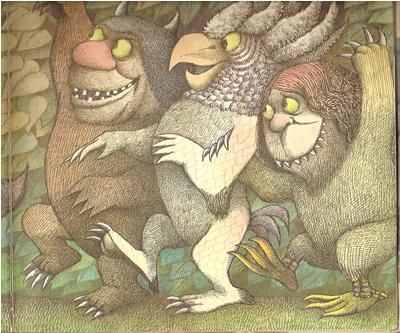
* Ninth picture: The monsters all seem kind of cuddly, with soft
edges and friendly expressions, even though the text describes
them as terrible in many senses. Again, there is an apparent contradiction
between picture and text. Max now does not seem apprehensive,
but rather angry at them - as we might imagine his mother (never
seen) to be with him. He looks mildly disgusted. The number of
wild things suggests that Max’s imagination has fragmented
the aggression they represent, so as better to control them (Spitz
130).
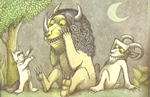
* Tenth picture: Role reversal: Max shouts "Be still"
and tames the monsters by facing them directly without blinking.
He acts to them as Mother sought to act to him, but they obey
better than he did. He is in charge, and they look frightened.
Psychologically, this scene represents a mastering of the violent
"wild-thing" impulses - we can only deal with these
impulses by facing them directly.
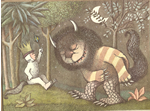
* Eleventh picture: The cuddly wild things now bow to him; he
appears haughty as he is addressed as "king of all wild things."
He is completely in control, as earlier (in the "real world"
of home) he was completely out of control.
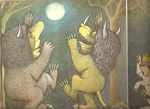
* Twelfth picture: This is the first of three illustrations that
each occupies an entire two-page spread, with no text. The imagination
has achieved a release as the monsters seem to be playing a game.
Max joins in, his mouth open wide, yelling. They are creating
a "wild rumpus" in the forest, which is still his bedroom.
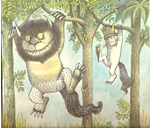
* Thirteenth picture: Max looks happy, with the monsters joining
in the fun.
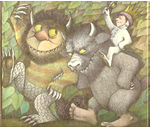
* Fourteenth picture: Triumphant Max, as in the previous two illustrations,
is at the center of the two-page spread. The frame has become
almost completely filled with monsters, but they remain benign
and under Max's control, as evidenced by his riding atop one of
them, wielding his sceptre.
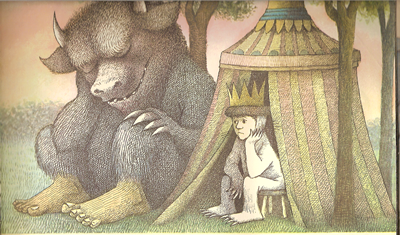
* Fifteenth picture: Max treats the wild things as he was treated,
but he is lonely as king of the wild things - for the first time
since arriving in this place, he looks sad in the picture.
* Sixteenth picture: The verbal repetition of Max's threat to
his mother ("We'll eat you up") is transformed into
an expression of love (consistent with the sometimes over-exuberant
behavior of aunts and uncles to a young child, which was one of
the models for Sendak's wild things). To what extent is Max's
initial threat also an expression of love? Max waves back happily
as he leaves the wild things for home.
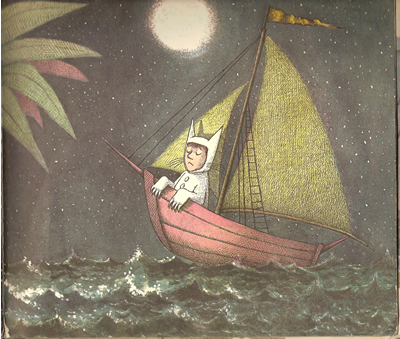
* Seventeenth picture: Max sails home, looking a little sad -
contrite maybe?
* Eighteenth picture: Max appears very happy and tired as he arrives
home to find his supper awaiting him, and he is already undergoing
a transformation back into boy - he has put back the hood of his
wolf suit. Critic George Bodmer has pointed out that Max's wolf
costume represents a role that he plays; at the end of the book,
having slipped out of the role of "wild thing," he also
appears for the first time without the wolf suit fully in place.Note
that the moon in the window is now full, whereas in the earlier
scenes of the bedroom, it was a crescent - thus the illustration
suggests that the seemingly fanciful notion of great periods of
time elapsing, as Max "sailed in and out of weeks and almost
over a year" is perhaps not so fanciful after all. The full
moon is also a symbol of fulfillment or completeness, consistent
with Max's apparent integration of his negative impulses through
his visit to the wild things.